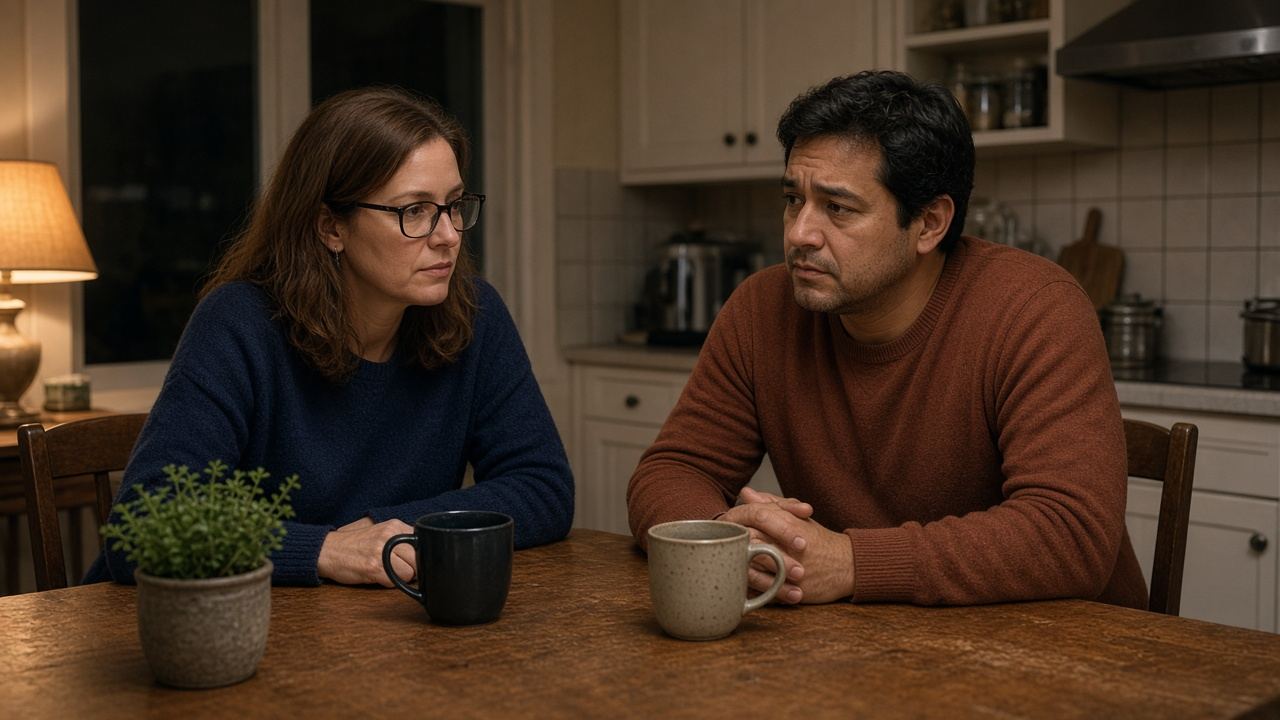
After a sharp fight, the body often does a very simple thing: it pulls back. You can still share a house, pass the salt, ask about pickup times, and feel a wall in the middle of the room. Desire, in that atmosphere, usually goes quiet. Some people want reassurance in a physical way right after an argument. Others cannot imagine being touched until the air has changed. Both reactions are common. They just don’t always show up in the same couple at the same time, which is how a fight about the dishes turns into a second fight about the cold shoulder in bed.
Intimacy after conflict is not mainly a technical problem. It is a safety problem. If you don’t feel emotionally steady with someone, your nervous system may not be interested in getting physically close to them, and no clever advice about lighting will fix that first.
This is about ordinary relationship conflict: the recurring argument, the harsh word, the week of tight silence. It is not advice for a relationship that is frightening, controlling, or violent. Those situations need a different kind of help, and a blog about getting close again is the wrong tool.
Why a fight can shut desire down so fast
An argument is a stress event. Heart rate goes up. Muscles tighten. The mind rehearses comebacks. Afterward, some people recover quickly. Others stay in a defensive state for hours or days, even after the topic itself has been dropped. In that state, touch can feel like too much, or like a demand, or like a way of skipping the repair.
There is also meaning layered onto the fight. If the argument was about feeling ignored, then a later invitation to have sex can sound like, let’s skip the part where you take me seriously. If the argument was about feeling unwanted, then a partner who needs space can sound like further rejection. The same evening can hold two accurate hurts that point in opposite directions.
Couples often develop a pattern. One person reaches for reconnection through closeness, including sex. The other person needs a sincere conversation, an apology, or just time, and reads the reach as pressure. The first person then feels twice rejected. If that cycle repeats, intimacy becomes another arena for the same conflict, which is a grim place to leave a relationship.
I have watched this in friends’ relationships and, if I am honest, recognized the outline of it closer to home. The details vary. The loop is familiar.
Repair comes before chemistry
Therapists talk a lot about repair attempts: the small moves that say, I still want to be on the same side as you. A genuine apology. A glass of water brought over without a speech. “I hate that we got there, and I want to understand what I missed.” Humor, if it is kind and well timed, can help, but a joke that dismisses the other person’s point is not a repair. It is a sequel.
A repair does not require you to abandon a real disagreement. You can still think you were right about the budget and also admit that you were harsh, or that you kept score, or that you brought up an old injury to win a new point. The second of those is often the thing the other person needed to hear.
Don’t use sex as the apology, and don’t demand it as proof that the apology was accepted. Sex can be part of coming back together later, when both people actually want it. As a truce mechanism, it tends to leave one person feeling used and the other feeling that the issue was never really faced. Then the next fight starts sooner, with less patience.
What a decent repair can look like in practice
Give the worst of the adrenaline a little time to fall. If you are still shaking or sharp, take a break, and name the break so it doesn’t feel like abandonment. “I need twenty minutes, and then I want to come back to this” is a different message from a slammed door.
When you do come back, get specific. “I am sorry I called you dramatic” is more useful than “I am sorry you felt upset,” which is a non-apology in a thin disguise. Say what you will try to do differently, without making a vow you cannot keep. Listen to the other person’s version without immediately litigating the facts. You can come back to the facts later if they still matter.
Some couples do well with a short walk after a fight, or with sitting at the table rather than standing in the kitchen, where arguments seem to grow extra teeth. The setting is less important than the tone. If you notice yourself cataloguing every past offense, stop. That is a different conversation, and it usually needs more time, maybe a counselor, not a midnight pile-on.
Physical closeness after a repair should be invited, not assumed. “Are you okay being close right now, or do you still need space?” is a slightly formal sentence that can save you both a clumsy misread. If the answer is space, accept it without a penalty. If the answer is yes, start with the kind of closeness that feels possible: sitting together, a hand, a longer hug than usual. Let the rest happen only if it wants to.
When one of you wants to “make up” physically and the other doesn’t
This mismatch is so common that it deserves its own warning. The partner who wants sex after conflict may be looking for reassurance: we are okay, you still want me, the threat has passed. The partner who doesn’t may still be feeling raw. If the first person pushes, the second person may give in to end the tension, and then feel worse. If the second person refuses and the first person withdraws in anger, the refusal becomes another injury.
Name the need underneath. “I want to know we are still okay” can be answered with words, with a hug, with a plan for the next morning, not only with sex. “I cannot be close like that until I believe you heard me” can be answered with patience and a better conversation, not with a lecture about going to bed angry.
If this is the recurring pattern after almost every disagreement, talk about the pattern on a calm day, not in the aftermath. A couples therapist can be very useful here, because the pattern is often faster than either person’s good intentions.

Rebuilding closeness after a longer freeze
Sometimes the issue is not one fight, but a month of careful distance. You have been polite. You have been tired. You have not been kind in the private ways that keep a relationship from going flat. Getting close again then takes a little more than a single apology.
Start with ordinary warmth in daylight. Shared meals without the television for a night. A question about the other person’s week that is not a logistics question. A small kindness that is not a bargaining chip. Sex often returns more easily when the rest of the relationship has stopped feeling like a workplace.
You may also need to talk about the backlog. Not in one enormous midnight monologue, but in pieces. What have you been angry about that never got a real ending? What have you stopped asking for? If every attempt turns into the same fight, bring in a third person who is trained for this. There is no prize for solving a long freeze by sheer stubbornness.
Be careful with grand romantic gestures if the daily tone is still cold. A big dinner does not erase a week of contempt. The daily tone is the thing that has to change.
Some couples also need to look at the conditions around the fights. Exhaustion, alcohol, and late-night “discussions” make ordinary disagreements sound more final than they are. If most of your worst arguments start after 11 p.m., change the clock, not just the vocabulary. A rule as simple as “we pause this until morning” can prevent a lot of damage, provided both people actually come back to it and don’t use the pause as a disappearing act.
If closeness has been absent for a long time, you may feel shy with each other, almost like starting over. That awkwardness is not a sign that the attraction is gone. It is often a sign that you have been living in parallel. Going slowly is allowed. So is saying, out loud, that you feel rusty and you would rather be clumsy together than stay polite and far apart.

When conflict is a pattern, or when it is more than conflict
If arguments regularly include insults, intimidation, breaking things, checking up on you, isolating you from friends, or any kind of forced sexual contact, that is not a communication style. That is harm. You do not owe that relationship a better makeup routine. Seek help from people and services built for safety. Friends, a local support service, or emergency help if you are in danger, are the right resources. Do not use the advice in this article to try to manage a partner who is frightening.
For the more ordinary, still painful, high-conflict couple, weekly counseling can slow the cycle and teach you both how to repair before the silence lasts a week. That is not a sign that the love is gone. It is a sign that you are tired of doing it the hard way.
A short word of caution
This article is educational, not therapy and not a safety plan. If conflict at home leaves you frightened, or if intimacy is being used as pressure, get support from a qualified professional or a local service that can help you stay safe. If you and your partner are basically decent to each other and still stuck in the same fight, a couples therapist can help you rebuild closeness in a steadier way. Desire usually comes back more readily after respect does. That is a less glamorous sequence than a movie makeup scene, and it lasts longer.
Leave a Reply